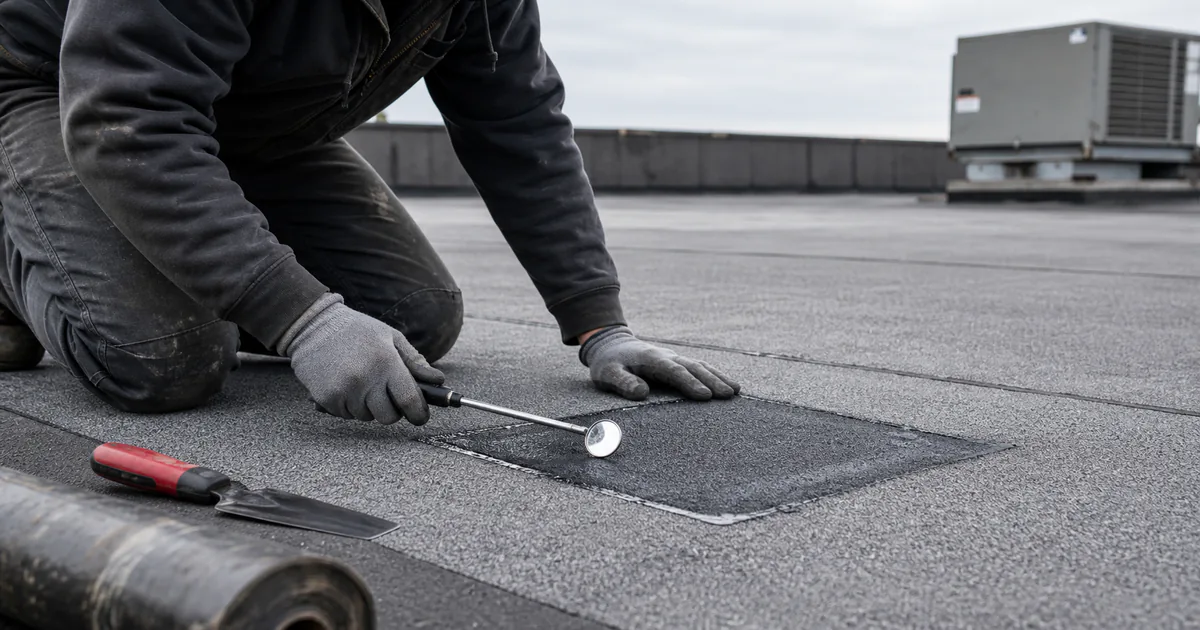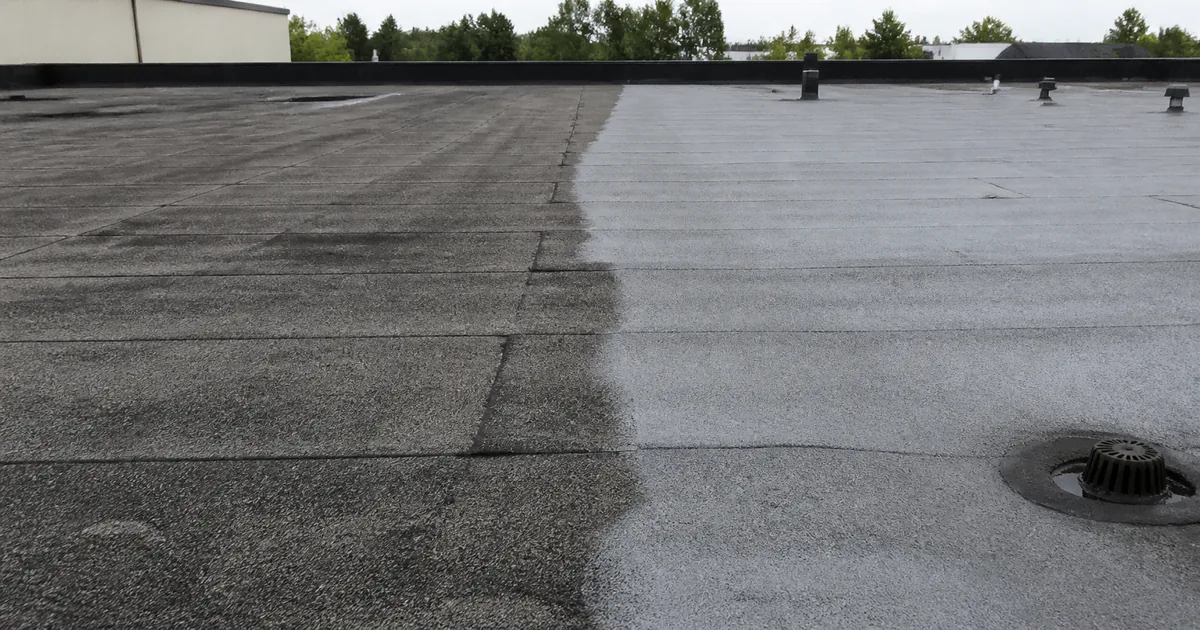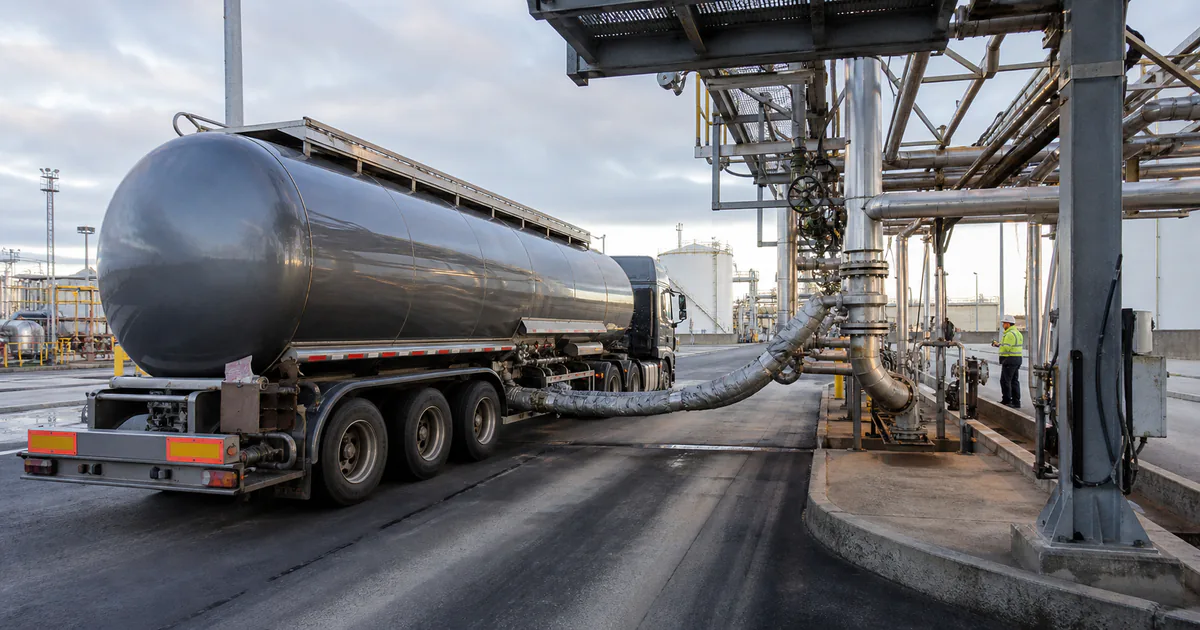
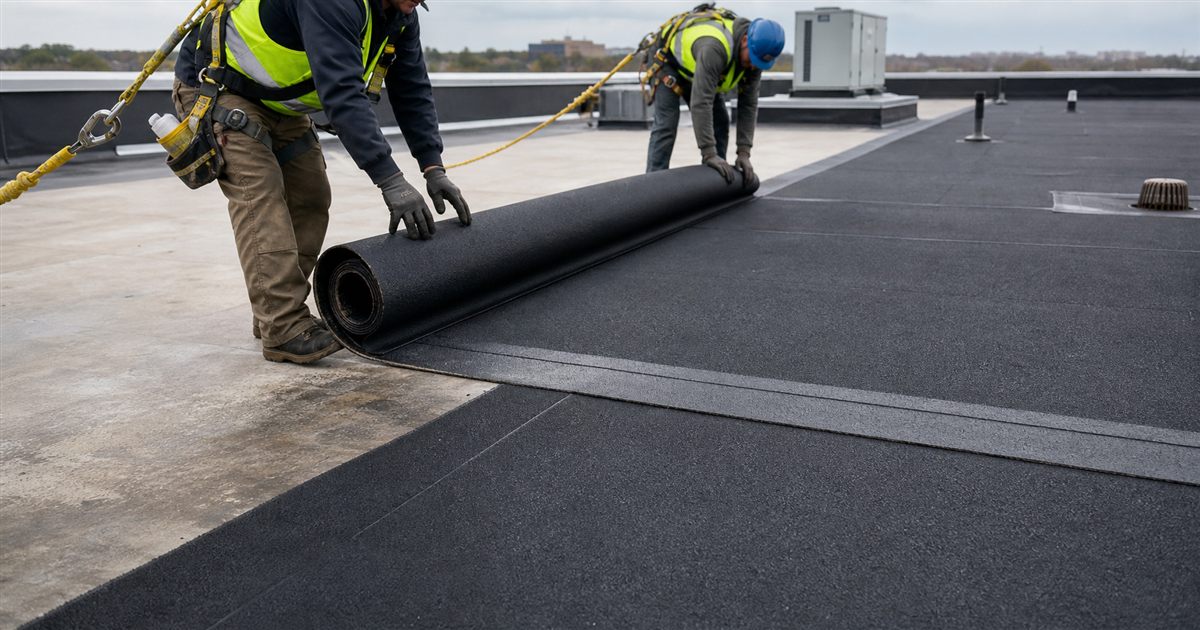
If you are wondering what is modified bitumen roofing, it is a factory-made asphalt membrane strengthened with polymers and usually reinforced with polyester, fiberglass, or a composite mat. Roofers install these rolled sheets in one or more bonded plies to protect flat and low-slope roofs from water and weather.
The polymer changes how the asphalt responds to heat, cold, movement, and physical stress. Two main versions are available: rubber-like SBS and plastic-like APP. Products also differ in reinforcement, surface finish, thickness, installation method, and intended roof assembly.
Modified bitumen, often shortened to mod bit, is widely used on commercial buildings. It can also protect home additions, garages, porches, and other residential sections where the slope is too low for ordinary shingles. Choosing a suitable system requires more than selecting a membrane roll; drainage, insulation, deck condition, flashing, workmanship, and local code all affect performance.
Quick Definition
Modified bitumen roofing is an asphalt-based membrane enhanced with rubber or plastic polymers. Reinforcement gives the sheet strength, while mineral granules, foil, or a compatible coating protects its surface. The membrane is primarily designed for flat and low-slope roofs and may be installed in single- or multi-ply assemblies using several approved attachment methods.
What Is Modified Bitumen Roofing Made Of?
A modified bitumen roof membrane combines several materials, each serving a different purpose.
The asphalt compound provides water resistance and adhesion. A polymer modifier alters its performance so that it is better suited to roofing than unmodified asphalt alone. A reinforcement mat supplies tensile strength and dimensional stability. The exposed surface protects the asphalt from sunlight, weathering, and physical wear.
Typical reinforcement materials include:
-
Polyester for strength, flexibility, and resistance to movement
-
Fiberglass for dimensional stability
-
Composite reinforcement that combines selected properties of both
A finished roll may have mineral granules on top, similar to the surface of asphalt shingles. Other products are smooth, sanded, coated, or faced with foil. Smooth membranes may serve as a base ply, interply, flashing component, or surface prepared for a compatible coating.
Modified bitumen is a family of roofing materials rather than one standardized sheet. Two membranes with similar appearances may have different polymers, reinforcement, thicknesses, surfacing, installation requirements, or warranty conditions.
APP and SBS Modified Bitumen Compared
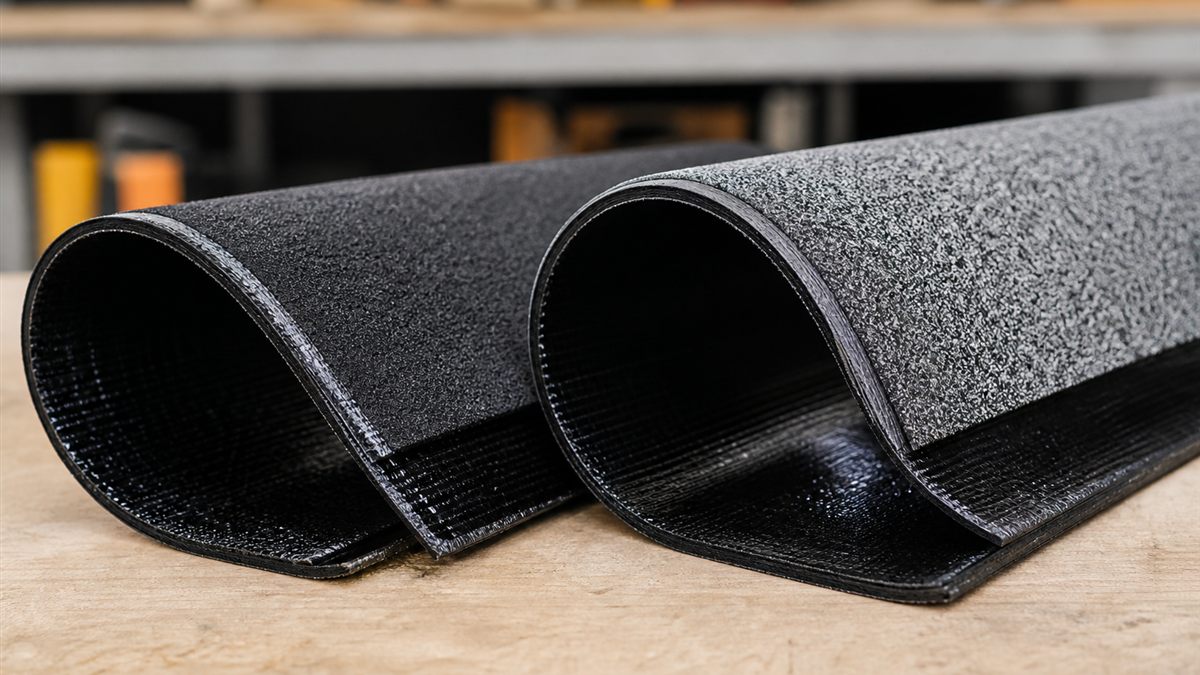
APP and SBS describe the polymers most commonly used to modify roofing asphalt. They should not be treated as different brand names or simple quality grades.
SBS stands for styrene-butadiene-styrene. It gives the asphalt rubber-like or elastomeric behavior. SBS membranes are known for flexibility and their ability to recover after being stretched.
APP stands for atactic polypropylene. It produces a more plastic-like or plastomeric material associated with heat resistance and dimensional stability.
| Feature | SBS-modified membrane | APP-modified membrane |
|---|---|---|
| Polymer behavior | Rubber-like or elastomeric | Plastic-like or plastomeric |
| Common performance emphasis | Flexibility and elastic recovery | Heat response and dimensional stability |
| Reinforcement | Polyester, fiberglass, or composite | Commonly polyester or another approved reinforcement |
| Installation possibilities | Self-adhered, cold adhesive, hot asphalt, mechanical attachment, or heat welding, depending on the product | Often heat welded, although other approved systems may be available |
| Selection basis | Climate, deck, movement, detailing, assembly and specification | Climate, deck, movement, detailing, assembly and specification |
SBS is not automatically better than APP, nor is APP suitable only for hot climates. The membrane is one part of a complete system. Reinforcement, surface treatment, installation quality, number of plies, roof geometry, and manufacturer requirements can be just as important as the polymer type.
It is also inaccurate to say every APP membrane must be torch-applied or every SBS product is self-adhered. The approved application method is determined by the specific product and tested roof assembly.
The Layers Beneath the Visible Membrane
A finished roof is more than the cap sheet visible from outside. A complete modified bitumen roofing system may contain several layers between the building and the weather.
| Layer or component | Main function |
|---|---|
| Roof deck | Provides structural support |
| Vapor retarder, where required | Controls vapor movement through the assembly |
| Insulation | Supplies thermal resistance and helps meet energy requirements |
| Cover board | Creates a stable substrate and improves impact resistance |
| Base sheet or base ply | Provides a lower waterproofing layer |
| Interply membrane, where used | Adds redundancy and membrane strength |
| Cap sheet | Forms the main weathering surface |
| Flashing and accessories | Seal edges, penetrations, drains and transitions |
| Granules, foil or coating | Protects the membrane from ultraviolet exposure and weathering |
Not every roof needs each component. Vapor-control requirements depend on climate, indoor conditions, roof design, and local building practice. Some assemblies place a membrane over an approved cover board, while others use mechanically attached or adhered base sheets.
One-ply, two-ply and multi-ply systems
A ply is a membrane layer, not the same as insulation or a cover board. A one-ply mod bit application uses one primary membrane sheet in the waterproofing portion of its approved assembly. A two-ply system generally combines a base ply and cap ply. Other systems use additional membrane layers.
More plies can provide greater waterproofing redundancy, but ply count alone does not prove quality. Poor seams or defective flashing can compromise even a thick assembly. Conversely, a properly designed system with fewer plies may be appropriate for its intended building and warranty.
Modified bitumen should not be casually classified as the same type of “single-ply roofing” as TPO, PVC, or EPDM. Even when a mod bit system uses one principal sheet, its asphalt-based composition, detailing, and application methods remain different.
How Modified Bitumen Membranes Are Installed
Installation begins with a sound, dry, compatible substrate. The designer or contractor selects the deck, insulation, cover board, membrane, attachment method, and flashing details as one tested assembly.
Common application methods include the following.
Torch application
A torch-applied membrane is heat welded by trained roofers using controlled flame equipment. Heating activates the underside and bonds the sheet to the compatible surface or underlying ply.
Torch work creates serious fire risks around combustible decks, wall cavities, insulation, penetrations, and concealed spaces. It requires trained personnel, suitable equipment, a hot-work procedure, fire-control measures, and compliance with local regulations. It is not an appropriate casual DIY process.
Self-adhered application
Self-adhered membranes have a factory-applied adhesive protected by release film. They can reduce open-flame work and may produce less installation odor than hot asphalt or some solvent-based adhesives.
They still require correct substrate preparation, temperature conditions, sheet alignment, rolling, lap treatment, and flashing. “Peel and stick” does not mean the membrane can be placed over a dirty, wet, uneven, or incompatible roof deck.
Cold-applied adhesive
An approved cold-process adhesive bonds the membrane without a torch or kettle of hot asphalt. The contractor must use the specified coverage rate, drying conditions, compatible primer, and ventilation procedures.
Some adhesives contain solvents or other volatile components. Product-specific requirements for ventilation, ignition control, storage, and personal protection remain important.
Hot-asphalt application
Certain modified bitumen membranes can be set in hot asphalt. This method is associated with multi-ply roofing and requires professional temperature control, heated equipment, and safe material handling.
Hot asphalt can cause severe burns and generate fumes. Its use should follow the membrane manufacturer’s instructions and the project’s safety plan.
Mechanical attachment
Approved base sheets, insulation, or membrane components may be secured with fasteners and plates. Other plies can then be bonded using an approved method. The fastener pattern must account for the deck and required wind-uplift resistance.
These methods are not freely interchangeable. Substituting an adhesive, fastener pattern, primer, or seam treatment can affect performance, fire classification, wind rating, and warranty coverage.
Why Drainage Still Matters on a “Flat” Roof
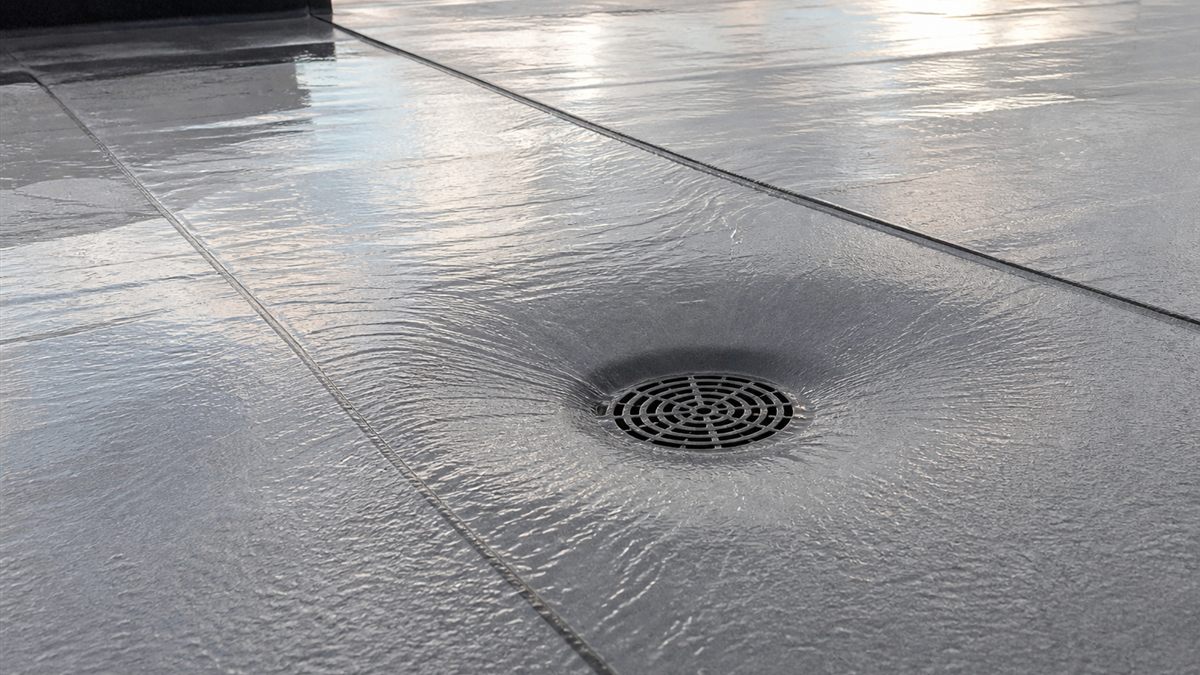
A flat roof should not be perfectly level. It normally needs designed slope so water can reach drains, scuppers, or gutters. Deflection, blocked outlets, settlement, poor construction, or compressed insulation can create low areas where water remains after rain.
Ponding water can:
-
Increase stress on seams and flashings
-
Collect dirt and support biological growth
-
Add weight to the roof
-
Accelerate deterioration in vulnerable areas
-
Conceal small punctures or failed laps
-
Freeze and thaw in cold climates
A waterproof membrane does not eliminate the need for drainage. Some products and warranties have specific limits or exclusions related to prolonged ponding. Adding a coating over standing-water areas is not a substitute for correcting a drainage defect when the roof design or substrate is the underlying problem.
Drains and scuppers should remain clear, but roof access must be managed safely. Owners should not walk onto wet, icy, damaged, or unprotected roofs without the proper access and fall-protection arrangements.
Benefits of a Modified Bitumen Roof
Modified bitumen remains common because it combines factory-controlled sheets with familiar multi-layer asphalt roofing principles.
Waterproofing redundancy
A multi-ply assembly provides more than one membrane layer between the building and the weather. If one surface experiences minor damage, another bonded ply may continue to provide protection until repairs are made. This redundancy depends on sound seams and flashing.
Resistance to punctures and tears
Reinforcement helps the membrane resist impacts, localized stress, maintenance activity, and limited roof traffic. It is not indestructible. Dropped tools, sharp equipment edges, fastener movement, or frequent uncontrolled walking can still cause damage.
Flexibility and movement control
Polymer modification improves the way the asphalt responds to expansion, contraction, and building movement. SBS is particularly associated with elastic behavior, but overall flexibility also depends on reinforcement, temperature, membrane design, and age.
Repairable detailing
Trained roofers can often repair localized punctures, open laps, surface damage, and flashing defects using compatible materials. A repair must extend to the true source of the problem rather than covering the point where water appears indoors.
Familiar construction methods
Many commercial roofing contractors have experience detailing bituminous membranes around curbs, drains, penetrations, parapets, and equipment supports. This can be useful on complicated roofs with many transitions.
Limitations to Consider
A mod bit roof is not the right answer for every building.
Installation can be labor intensive, especially in a multi-ply assembly with numerous penetrations. Some methods involve open flame, hot material, fumes, or solvent-containing adhesives. Work near occupied areas may require scheduling, ventilation, odor control, and additional safety planning.
The material can also be heavier than some synthetic single-ply alternatives. The weight of the complete assembly, including existing roof layers, insulation, cover boards, and any retained surfacing, should be considered before a recover project.
Dark membranes can absorb considerable solar heat. Mineral granules, light-colored cap sheets, foil facings, or compatible reflective coatings may improve solar reflectance, but energy performance also depends on insulation, climate, roof condition, and the tested surface product.
Every roll creates seams. Correct side laps, end laps, flashing, terminations, and penetrations are central to watertightness. Poor alignment or bonding can leave channels where water enters.
Finally, modified bitumen is not a cure for structural movement, wet insulation, inadequate drainage, or a deteriorated roof deck. Those conditions must be diagnosed and addressed as part of the roofing project.
Modified Bitumen Roof Lifespan and Cost Factors
A well-designed, properly installed, and maintained modified bitumen roof may serve for roughly 15 to 30 years. That range is not a warranty or promise. Some roofs fail sooner, while favorable systems may remain serviceable longer.
Service life depends on:
-
Number and quality of membrane plies
-
APP or SBS product formulation
-
Reinforcement and cap-sheet surfacing
-
Installation workmanship
-
Roof slope and drainage
-
Climate and ultraviolet exposure
-
Hail, wind, snow, and temperature cycling
-
Frequency of roof traffic
-
Condition of flashings and penetrations
-
Inspection and repair timing
-
Moisture trapped within the assembly
No single cost figure applies worldwide. Material prices, labor rates, tear-off requirements, insulation thickness, roof access, drainage work, deck repairs, safety controls, building height, warranty level, and local code can change the installed price substantially.
A low initial quote may exclude wet-insulation replacement, new cover board, improved drainage, edge-metal work, permits, or removal of existing layers. Compare contractors using the same written scope rather than the headline price alone.
Maintenance and Warning Signs
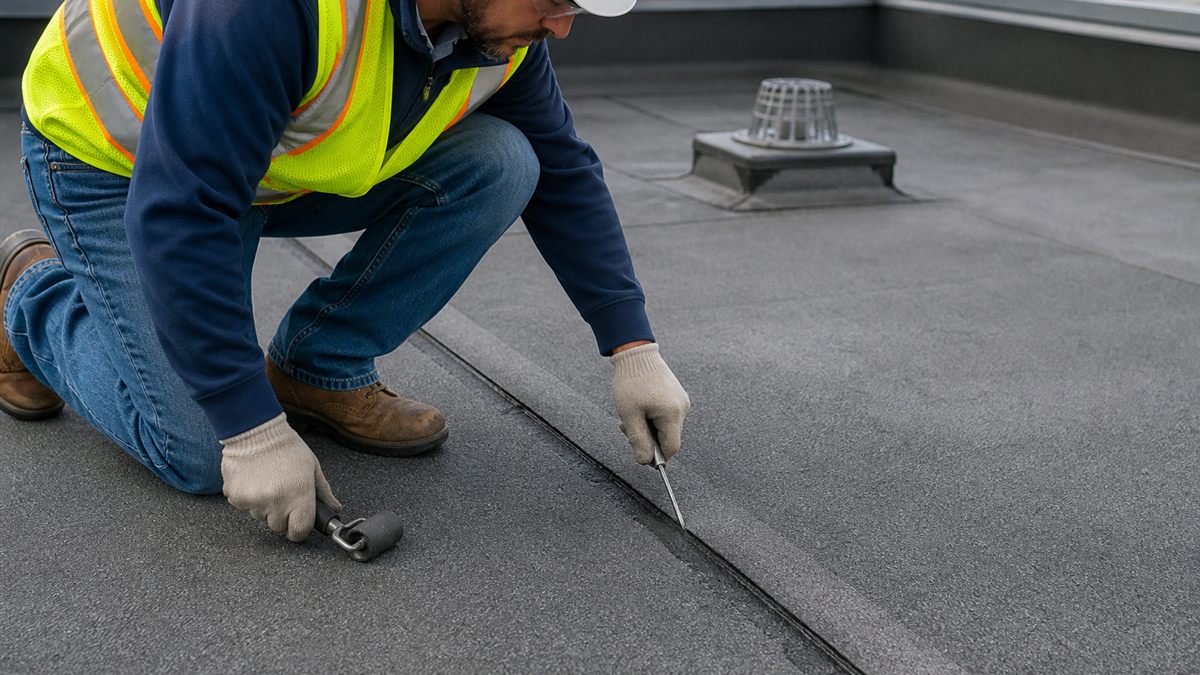
A qualified roof professional should inspect the system at suitable intervals and after severe weather or major rooftop work. Building owners can also monitor indoor warning signs without climbing onto the roof.
Important inspection areas include:
-
Side laps and end laps
-
Drains, scuppers, and gutters
-
Flashing around curbs and penetrations
-
Parapet and edge terminations
-
Punctures or impact marks
-
Blisters and raised areas
-
Cracks or splits
-
Exposed asphalt and granule loss
-
Deteriorated coatings
-
Loose equipment or abandoned fasteners
-
Evidence of ponding water
-
Interior stains, damp insulation, or odors
A blister can form when air or moisture becomes trapped between layers. It should not be cut open without knowing its cause and the condition below it. Likewise, a stain on the ceiling may be far from the exterior entry point because water can travel through insulation, deck joints, or structural channels.
A roof coating may restore weathering protection in a suitable, dry, stable system. It cannot repair saturated insulation, a corroded deck, widespread delamination, badly failed seams, or active structural movement. Moisture surveys, test cuts, or other professional investigation may be needed before restoration.
How It Compares With Other Low-Slope Systems
| System | General structure | Common decision factors |
|---|---|---|
| Modified bitumen | Reinforced polymer-modified asphalt sheets, often installed in multiple plies | Durability, repairability, detailing, weight and installation method |
| Built-up roofing | Alternating layers of bitumen and reinforcing felts, often with surfacing | Redundancy, proven performance, weight, odor and labor |
| TPO | Thermoplastic single-ply membrane with heat-welded seams | Reflectivity, installation speed, seam welding and membrane formulation |
| PVC | Thermoplastic single-ply membrane with welded seams | Chemical resistance, detailing, cost and compatibility |
| EPDM | Synthetic rubber single-ply membrane | Flexibility, large sheets, seam system, ballast or attachment method |
Modified bitumen often appeals to owners who value multiple bonded layers, puncture resistance, and asphalt-based flashing techniques. TPO or PVC may provide a lighter, reflective single-ply assembly with fewer field seams when large sheets are used. EPDM offers flexible rubber sheets and different attachment options. BUR provides traditional multi-ply redundancy but may involve more material and labor.
The strongest choice depends on the deck, slope, drainage, building use, indoor operations, climate, foot traffic, fire and wind requirements, contractor expertise, warranty terms, and long-term maintenance plan.
Safety and Contractor Selection
Modified bitumen roof installation involves working at height, handling heavy rolls, and using adhesives, hot materials, mechanical equipment, or open flame. Fall protection, safe access, weather monitoring, ventilation, and product-specific personal protective equipment are fundamental.
Torch application requires particular attention to combustible materials and hidden voids. A professional plan may include a hot-work permit, appropriate extinguishers, a fire watch, inspection of concealed areas, and post-work monitoring. The exact requirements depend on the site and local rules.
When comparing contractors, ask for:
-
Experience with the proposed APP or SBS system
-
A written description of every roof layer
-
Deck and moisture-evaluation procedures
-
Drainage and flashing details
-
The tested assembly and attachment method
-
Wind and fire classifications where required
-
Safety and occupied-building controls
-
Manufacturer and workmanship warranty terms
-
Inspection and maintenance requirements
Confirm what happens if wet insulation or deck damage is discovered after work begins. A clear contingency process is better than an unrealistic fixed scope that ignores concealed conditions.
Frequently Asked Questions
Is modified bitumen roofing suitable for residential buildings?
Yes. Although common on commercial properties, it can protect residential additions, garages, porches, and other low-slope sections. Suitability depends on slope, drainage, deck type, ventilation, appearance, local code, and the ability to install a tested system safely.
What is the difference between APP and SBS roofing?
SBS creates a more rubber-like membrane associated with flexibility and elastic recovery. APP creates a more plastic-like membrane associated with heat response and dimensional stability. Reinforcement, surfacing, installation, climate, and assembly design also matter, so neither polymer is universally superior.
Does a modified bitumen roof need a base sheet?
Many systems use a base sheet beneath a cap sheet, but not every approved assembly has the same ply arrangement. Some applications use a single principal membrane, while others contain two or more waterproofing plies. Follow the designed system rather than adding or removing layers independently.
Can modified bitumen roofing be installed without a torch?
Yes. Depending on the product, installation may use self-adhered backing, cold-process adhesive, hot asphalt, or mechanical attachment combined with another approved bonding method. A torch is only one option. The membrane and complete assembly must be approved for the selected technique.
How long does modified bitumen roofing last?
A broad planning range is about 15 to 30 years, but actual service life varies. Drainage, workmanship, membrane quality, climate, UV exposure, roof traffic, maintenance, storm damage, and the number of plies can shorten or extend performance. Warranty length is not automatically the same as physical lifespan.
Can a modified bitumen roof be repaired?
Localized punctures, open seams, flashing defects, and some surface damage can often be repaired with compatible materials. The roofer must identify the leak source and check for wet insulation or deck deterioration. Covering visible damage without diagnosing the assembly can trap moisture and delay a necessary replacement.
Is modified bitumen roofing waterproof?
A correctly designed and installed system forms a highly water-resistant roof covering. Its performance depends on bonded seams, flashing, penetrations, edges, drainage, and substrate condition. No membrane can compensate indefinitely for blocked drains, structural defects, or neglected damage.
Can a coating extend the life of a mod bit roof?
A compatible coating may protect a dry, stable membrane from further surface weathering and improve reflectivity. It is not suitable for every roof and will not correct saturated insulation, structural problems, severe delamination, or widespread seam failure. Professional evaluation should come before coating.
Choosing the System as a Complete Assembly
The practical answer to what is modified bitumen roofing is not merely “asphalt in a roll.” It is a reinforced, polymer-modified membrane that works with the deck, insulation, cover board, flashing, drainage, surfacing, and attachment method as one roof assembly.
APP and SBS products offer different material behavior, while installation options range from self-adhered and cold-applied systems to hot asphalt and professionally controlled heat welding. The right choice depends on the building and specification—not on one product feature. A thorough roof survey and a clearly defined system provide a stronger basis for selection than price or membrane type alone.

About the author
Misbah Shafique
Misbah Shafique writes practical guides on bitumen and asphalt quantities, paving calculations, material estimates, and project planning. Her work helps readers understand the numbers behind road, driveway, and construction jobs.
Plan your next project
Estimate bitumen before you order.
Use the calculator to turn your area and thickness into a practical material estimate.