If you are asking what is bitumen, it is a dark, highly viscous material made mainly from complex hydrocarbons. It occurs naturally in some geological deposits and is also produced during crude-oil refining. Its adhesive, water-resistant, and thermoplastic properties make it useful in roads, roofing, waterproofing, and protective coatings.
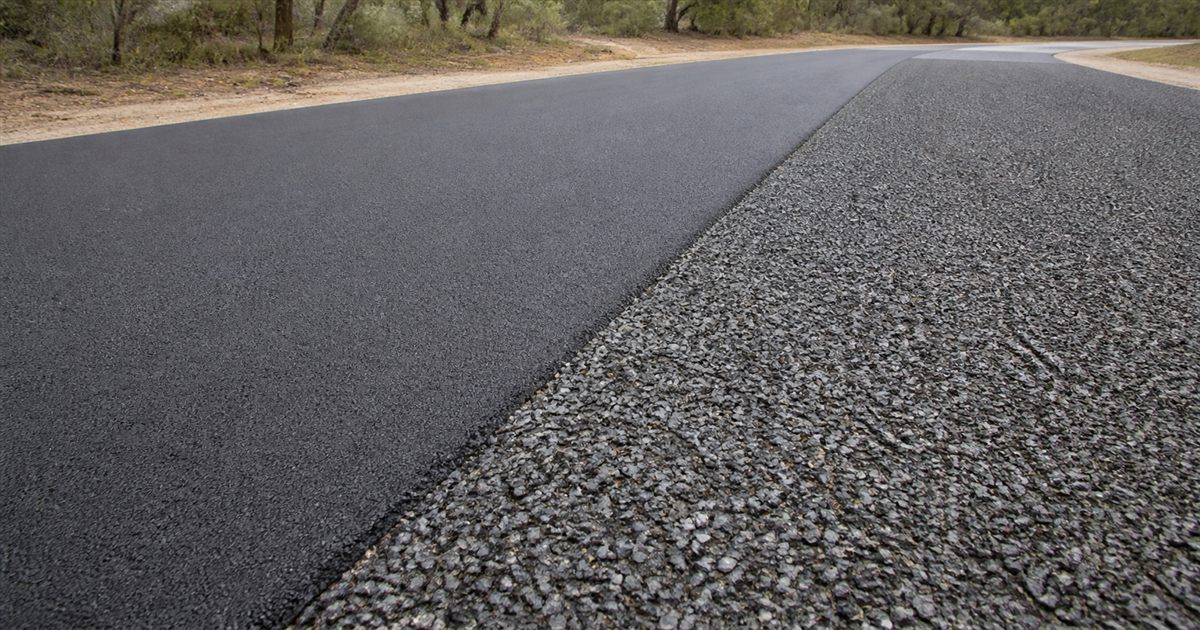
Bitumen is best known as the binder that holds stone and sand together in an asphalt pavement. It is not the entire road surface. The finished paving material contains mineral aggregate coated and bonded with a relatively small amount of bitumen.
The vocabulary can be confusing because “asphalt” has different meanings across regions. In the United States, bitumen is often called asphalt binder or asphalt cement. Elsewhere, asphalt usually means the complete mixture of bitumen and aggregate. Understanding that distinction makes its production, uses, and grades much easier to follow.
Quick Definition
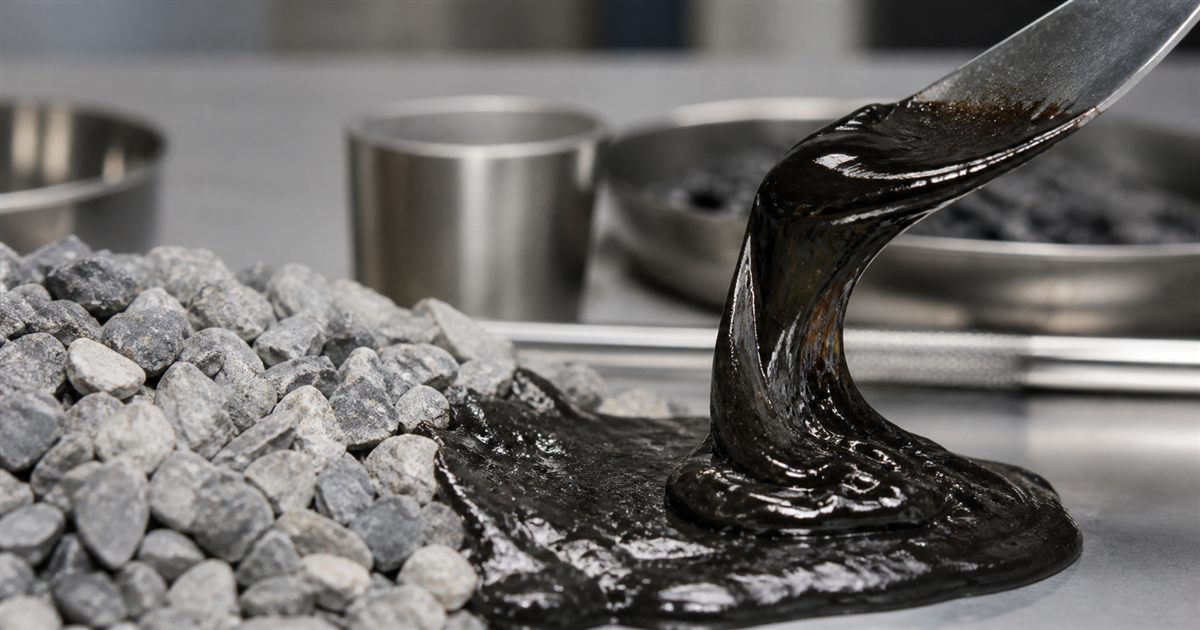
Bitumen is a black or dark-brown petroleum-based binder that behaves as a highly viscous liquid or semi-solid, depending on its grade and temperature. It coats and binds aggregate in asphalt mixtures and provides adhesion, flexibility, and resistance to water. It is also used in roofing membranes, sealants, coatings, and damp-proofing systems.
What Is Bitumen Made From?
Bitumen is not one pure chemical with a single molecular formula. It is a complex mixture of heavy hydrocarbon compounds, along with smaller quantities of sulfur, nitrogen, oxygen, and trace metals. Its exact composition varies with the crude-oil source, refining method, natural deposit, and any later modification.
Engineers often describe its structure using two broad groups: asphaltenes and maltenes.
Asphaltenes are the heavier, more rigid components. They contribute to stiffness, body, and viscosity. A binder with a different asphaltene balance may behave harder or resist flow differently at a given temperature.
Maltenes are the surrounding, more fluid portion. They include resins, aromatics, and saturates. These components help keep the asphaltenes dispersed and influence adhesion, flow, flexibility, and aging behavior.
This model is useful, but bitumen should not be treated as a simple recipe. Two products carrying the same broad grade can have different chemical details while still meeting the required engineering specification.
Is bitumen a solid or a liquid?
There is no single answer that applies under every condition. At ordinary temperatures, some grades appear solid or semi-solid. However, bitumen can continue to deform very slowly under sustained force. When heated, it becomes softer and flows more readily.
This temperature-dependent behavior is one reason bitumen is described as thermoplastic. Heating reduces its viscosity, making it easier to pump, mix, spray, or coat onto aggregate. Cooling increases viscosity and makes it firmer.
The same behavior creates an engineering challenge. A pavement binder must remain stiff enough to resist rutting during hot weather while retaining enough flexibility to avoid cracking during cold weather. Grade selection therefore depends on climate, traffic, pavement design, and the applicable project specification.
Where Bitumen Comes From
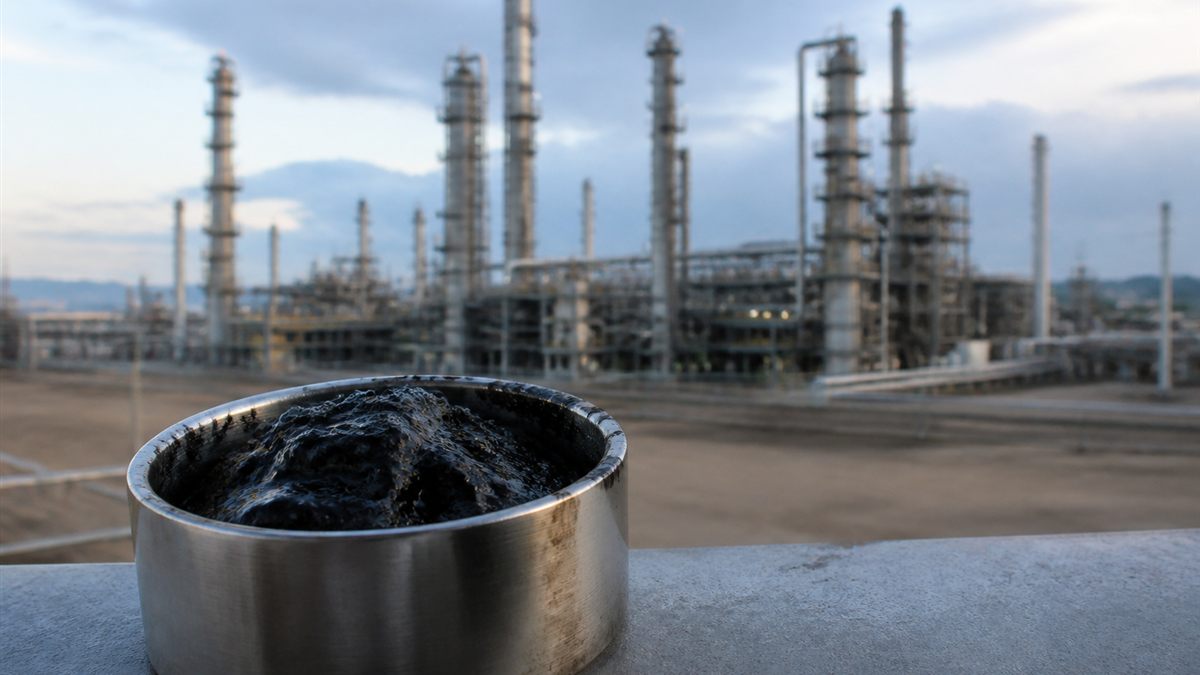
Commercial bitumen comes from two main sources: natural deposits and petroleum refining.
Natural bitumen
Natural bitumen develops when petroleum deposits change over very long periods. Lighter components may be lost through biological activity, evaporation, water washing, or geological processes, leaving a heavy and viscous material.
Natural deposits occur in several forms. Bitumen may seep to the surface, collect in pitch lakes, occupy rock fractures, or coat sand grains in oil-sands formations. Well-known deposits include Pitch Lake in Trinidad and Tobago and the Athabasca oil sands in Canada.
Natural bitumen may require extraction, separation, upgrading, blending, or other treatment before it becomes suitable for a particular use. Its presence in the ground does not mean it can automatically be applied as road binder.
Refinery-produced bitumen
Most paving and construction binders are associated with petroleum refining. A refinery separates crude oil into useful fractions according to their boiling behavior and other properties.
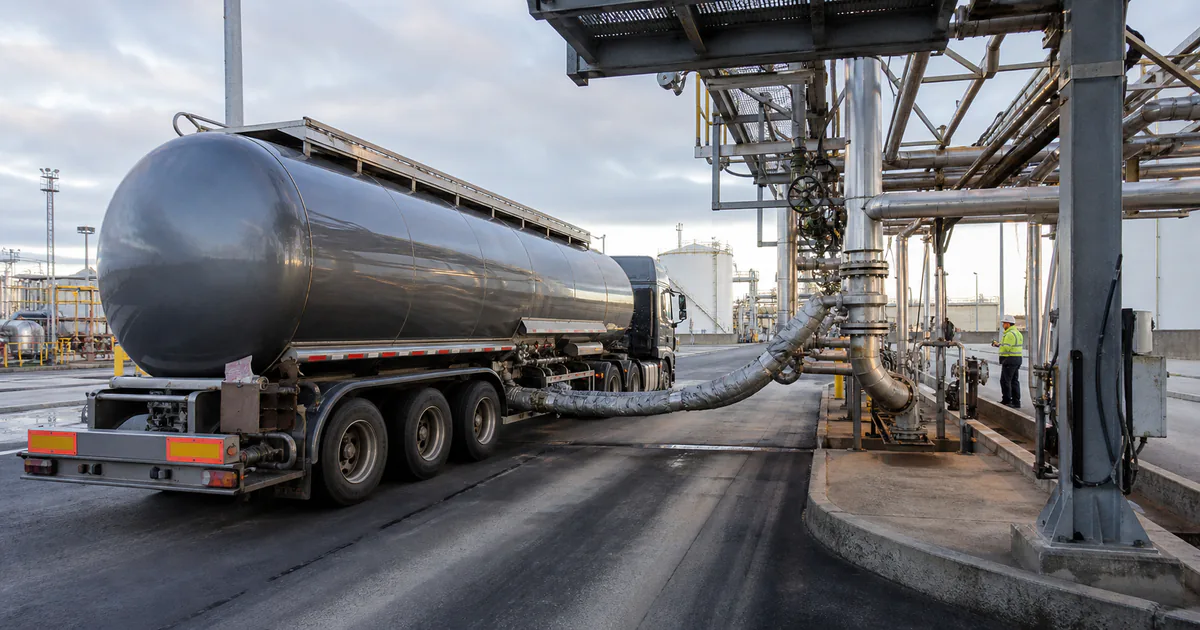
Lighter materials are removed during atmospheric distillation. The remaining heavy portion may enter a vacuum-distillation unit, where reduced pressure allows further separation without exposing the material to unnecessarily severe temperatures.
A heavy residue suitable for bitumen production remains after selected lighter fractions have been recovered. Refiners may blend or process this residue to meet specific consistency and performance requirements.
Not every crude oil produces the same quantity or quality of bitumen. Crude oils differ in composition, and some are more suitable for binder production than others. Calling bitumen a refinery residue describes its place in the process, but it does not mean it is uncontrolled waste. A finished construction binder must satisfy defined product and performance requirements.
Bitumen, Asphalt, Tar and Pitch Are Not Identical
These terms are frequently mixed together, especially in everyday conversation. Their technical meanings are different.
| Material | What it is | Typical use |
|---|---|---|
| Bitumen | A highly viscous petroleum-based or naturally occurring binder | Roads, roofing, waterproofing and sealing |
| Asphalt mixture | Bitumen blended with mineral aggregate and sometimes additives | Roads, runways, parking areas and paths |
| Coal tar | A material obtained from processing coal | Some industrial coatings and older sealing applications |
| Pitch | A broad name for thick, dark residues from several possible sources | Specialized coatings, sealing and industrial products |
In much of Europe, Asia, Africa, Australia, and the Middle East, bitumen means the binder, while asphalt means the mixture placed as pavement. In American usage, the binder may be called asphalt, asphalt cement, or asphalt binder. Asphalt concrete means the combined paving mixture.
Canada adds another context: bitumen may refer to the extremely heavy petroleum found in oil sands. If it is diluted with lighter hydrocarbons so it can move through a pipeline, the product is commonly called diluted bitumen or dilbit.
Coal tar is not another name for bitumen. It comes from coal-processing operations and has a different chemical profile. Likewise, “tarmac” is often used casually for a paved surface, but it should not be treated as the technical name of every modern asphalt mixture.
Why Bitumen Works as a Pavement Binder
A road surface must handle traffic, temperature changes, water, sunlight, and repeated loading. Bitumen helps an asphalt mixture meet these demands in several ways.
First, it coats individual aggregate particles. The coated stone, sand, and mineral filler can then be compacted into a dense, interconnected structure.
Second, the binder develops adhesion with the aggregate and cohesion within itself. Adhesion helps it remain attached to the stone. Cohesion helps the binder resist being pulled apart internally.
Third, bitumen provides controlled flexibility. Unlike a rigid cementitious material, a suitable asphalt binder can accommodate small movements and repeated wheel loads. Too much softness, however, can contribute to permanent deformation or rutting. Excessive stiffness can increase cracking risk.
Water resistance is another valuable property. Bitumen itself is generally resistant to water penetration, although moisture can still damage an asphalt mixture if water enters voids and weakens the bond between binder and aggregate. Good drainage, appropriate aggregate selection, correct compaction, and suitable additives may all influence moisture resistance.
A pavement does not consist entirely of bitumen. Mineral aggregate makes up most of an asphalt mixture by mass, while the binder commonly represents only a small percentage. The exact mixture design varies with aggregate properties, pavement layer, climate, traffic, and local specifications.
Main Types of Bitumen
Different applications need different combinations of consistency, flexibility, curing behavior, and temperature performance. The label “bitumen” therefore covers several product categories.
| Type | Main characteristic | Common application |
|---|---|---|
| Paving-grade bitumen | Produced and graded for pavement performance | Roads, parking areas and airport surfaces |
| Polymer-modified bitumen | Contains selected polymers to alter performance | Heavy traffic, demanding climates and specialized pavements |
| Bitumen emulsion | Bitumen droplets dispersed in water with an emulsifier | Surface treatments, tack coats and maintenance |
| Cutback bitumen | Binder temporarily thinned with a volatile solvent | Selected cold applications where permitted |
| Oxidized bitumen | Air-treated to increase hardness and softening point | Roofing and industrial products |
| Natural bitumen | Obtained from geological deposits | Specialized binders and industrial uses |
Paving-grade bitumen
Paving binders are selected to perform within the expected service conditions of a road. They may be classified by penetration, viscosity, or performance grade, depending on the country and specification system.
Polymer-modified bitumen
Polymers such as styrene-butadiene-styrene can change elasticity, temperature response, recovery, and resistance to deformation or cracking. Modified bitumen is not automatically necessary for every road. Its value depends on design demands, traffic, climate, construction quality, and cost.
Bitumen emulsion
An emulsion disperses small bitumen droplets in water with an emulsifying agent. This allows the binder to be handled in a more fluid form without keeping the whole product at conventional hot-mix temperatures. As the emulsion breaks and water leaves, the bitumen remains on the treated surface.
Emulsions are used for tack coats, surface treatments, patching, and other pavement-maintenance work. Cationic and anionic emulsions differ in electrical charge and interaction with aggregate.
Cutback bitumen
Cutback products use a petroleum solvent to reduce viscosity temporarily. As the solvent evaporates, the binder becomes firmer. Because these products can release volatile organic compounds and create fire or exposure concerns, their use may be restricted or replaced by emulsions in some regions.
Oxidized or blown bitumen
During air blowing, controlled air exposure changes the binder’s properties. The resulting oxidized bitumen generally has a higher softening point and different temperature response. It is commonly associated with roofing, waterproofing, pipe coating, and industrial products rather than ordinary road surfacing.
How Bitumen Quality Is Evaluated
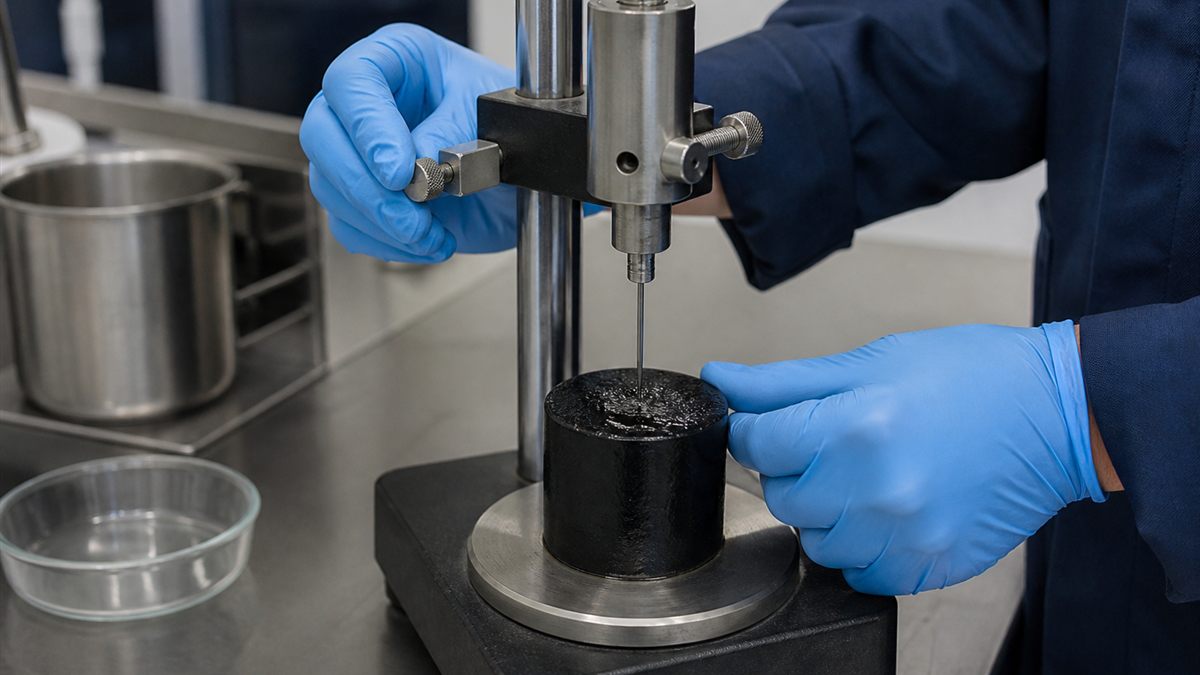
No single test describes every aspect of binder performance. Specifications use several measurements to determine whether a product suits its intended application.
Penetration measures consistency by recording how far a standardized needle enters the material under defined conditions. A higher penetration value generally represents a softer binder under the test conditions.
Viscosity measures resistance to flow at a specified temperature. It helps determine how the material will behave during pumping, mixing, coating, and compaction.
Softening point indicates the temperature range at which a binder reaches a defined level of softness under a standardized test. It is not simply an exact melting point because bitumen does not behave like a pure crystalline substance.
Ductility evaluates how far a prepared sample can stretch under set conditions before breaking. It provides information about tensile deformation, although modern performance evaluation may use additional rheological tests.
Flash point relates to the temperature at which vapors can ignite under specific test conditions. It is relevant to safe heating, storage, and handling.
Performance grading assesses binder behavior at high and low pavement temperatures. Specialized instruments can evaluate resistance to deformation, fatigue, and thermal cracking. The required grade should come from the project specification rather than a generic online recommendation.
What Is Bitumen Used For?
Road construction is the most visible application, but bitumen serves several other functions.
Roads and paved surfaces
Bitumen binds aggregate in flexible pavements used for highways, local roads, airport runways, parking areas, cycle paths, and footways. Different asphalt mixtures are designed for surface layers, structural layers, drainage, noise reduction, or specialized loading.
It is also used in maintenance treatments, including surface dressing, tack coats, crack sealing, and some patching products.
Roofing and waterproofing
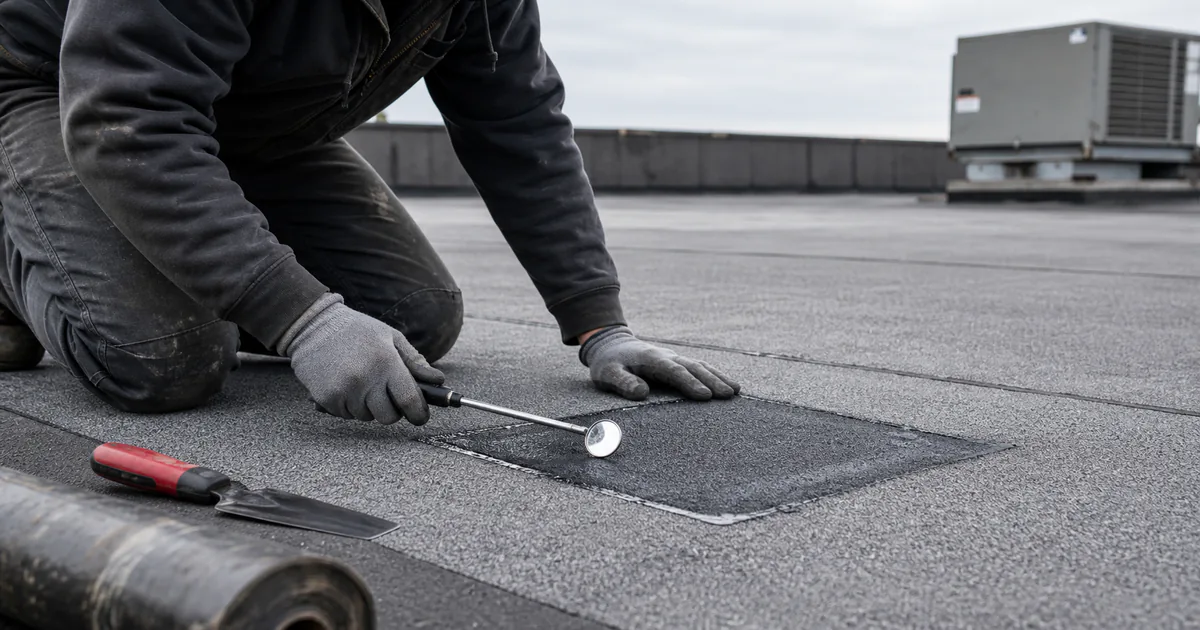
Water resistance makes bitumen useful in roofing membranes, built-up roofing, damp-proofing, foundations, bridge decks, and below-ground structures. A bituminous roofing product may include reinforcement, mineral surfacing, polymers, or other layers. It should not be assumed to have the same formulation as paving binder.
Sealing and protection
Industrial applications include joint sealants, pipe coatings, corrosion-resistant barriers, tank or reservoir linings, and cable protection. The exact product is formulated for its service temperature, movement, substrate, and exposure conditions.
Sound and vibration control
Dense bituminous materials can add mass and damping to panels. They may appear in certain automotive components, appliances, and building products designed to reduce vibration or transmitted noise.
Aging, Damage and Material Performance
Bitumen changes throughout production, installation, and service. Heat and air can cause lighter components to be lost and promote oxidation. Over time, the binder often becomes stiffer and less able to accommodate movement.
Stiffening can help resist flow to a point, but excessive aging increases cracking risk. Ultraviolet exposure, temperature cycles, water, traffic, and construction conditions can all influence pavement deterioration.
Common performance concerns include:
-
Rutting: permanent wheel-path deformation linked to mixture stability, temperature, loading, and binder behavior
-
Thermal cracking: contraction damage during cold conditions
-
Fatigue cracking: progressive damage under repeated loading
-
Stripping: loss of adhesion between binder and aggregate in the presence of moisture
-
Oxidative hardening: increasing stiffness as the binder ages
A pavement failure should not automatically be blamed on the binder. Aggregate quality, mixture proportions, drainage, layer thickness, compaction, base support, traffic, and workmanship may be equally important.
Recycling Bituminous Pavement
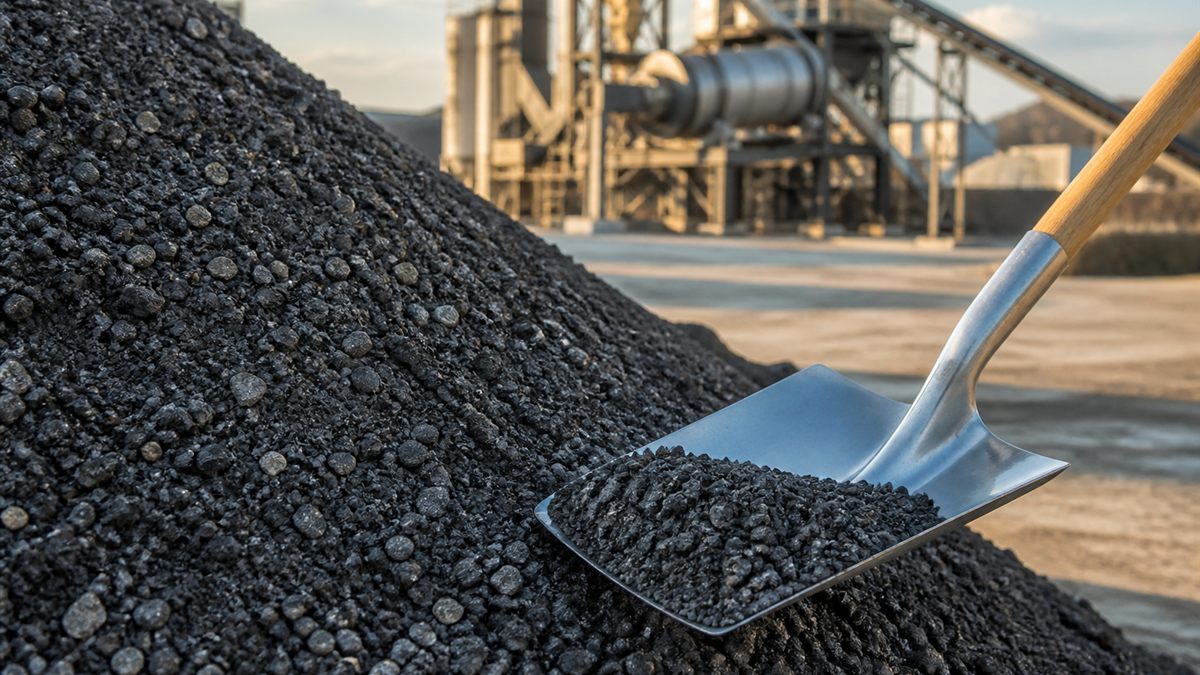
Old asphalt pavement can be milled, processed, and reused as reclaimed asphalt pavement, commonly shortened to RAP. This material contains both valuable aggregate and aged binder.
RAP may be incorporated into a new mixture after engineers account for its grading, binder content, stiffness, moisture, contamination, and effect on overall performance. Virgin binder, softer grades, recycling agents, or other adjustments may be used where the mixture design requires them.
Recycling does not mean the old binder instantly returns to its original condition. Aging and repeated processing can affect its properties. A successful recycled mixture depends on testing, proportioning, plant control, and project requirements.
The ability to recover aggregate and binder reduces demand for some new materials and limits the amount of pavement sent for disposal. Environmental performance still depends on transport, processing energy, production temperature, service life, and the quantity of new material required.
Safe Handling of Hot Bitumen
Cooled pavement and active hot-bitumen work do not create the same exposure conditions. The main workplace hazards increase when bitumen is heated, pumped, sprayed, mixed, or transferred.
Hot material can cause severe thermal burns. Heated operations can also produce fumes and aerosols, especially if temperatures are poorly controlled. Solvents in cutback products introduce additional vapor and fire risks.
Professional controls may include:
-
Temperature control and suitable equipment
-
Adequate ventilation
-
Protection from splashes and overfilling
-
Appropriate heat-resistant clothing and gloves
-
Face and eye protection selected for the task
-
Ignition-source control
-
Product-specific training and emergency procedures
-
Access to the current safety data sheet
Water must be managed carefully around hot bitumen because trapped moisture can expand rapidly and cause violent splashing or foaming. Workers should follow the supplier’s instructions, site procedures, and applicable occupational-safety requirements.
Industrial bitumen should not be heated as a casual do-it-yourself task. Roofing, paving, spill response, and heated transfer work require suitable equipment and trained personnel.
Frequently Asked Questions
Is bitumen the same as asphalt?
The answer depends partly on regional language. In the United States, asphalt may mean the petroleum binder itself. In many other countries, bitumen means the binder, while asphalt means the completed mixture of binder and aggregate. Using “asphalt binder” and “asphalt mixture” removes much of this ambiguity.
Is bitumen made from crude oil?
Most commercial construction bitumen is associated with refining suitable crude oils. Lighter fractions are separated, and the heavy remaining material is processed or blended to meet specifications. Bitumen also occurs naturally in oil sands, rock deposits, seeps, and pitch lakes.
Why is bitumen used in road construction?
It coats and binds mineral aggregate while providing adhesion, water resistance, and controlled flexibility. A suitable grade can accommodate traffic and temperature changes without becoming excessively soft or brittle. The pavement’s performance also depends on aggregate, drainage, compaction, layer design, and construction quality.
Is bitumen the same as tar?
No. Petroleum bitumen and coal tar come from different sources and have different chemical compositions. Bitumen is obtained from petroleum or natural deposits. Coal tar is produced during coal processing. Although both materials can look dark and sticky, the terms should not be used interchangeably.
Is bitumen waterproof?
Bitumen is strongly water resistant and is widely used in waterproofing products. However, successful waterproofing depends on the complete system, including surface preparation, membrane reinforcement, joints, overlaps, drainage, and protection from damage. A bituminous coating alone does not guarantee that every structure will remain watertight.
Why must bitumen be heated?
Many grades are too viscous to pump, mix, or coat efficiently at ordinary temperatures. Controlled heating lowers viscosity and makes processing easier. The required temperature depends on the product and operation. Overheating can increase aging, fumes, fire risk, and material damage, so professional temperature control is required.
Is bitumen recyclable?
Bitumen contained in old asphalt pavement can be recovered along with the aggregate through reclaimed asphalt pavement. The aged binder contributes to the new mixture, but its changed properties must be considered. Testing and mix design determine how much RAP can be used and whether additional binder or recycling agents are needed.
Is bitumen dangerous to handle?
Cold, finished pavement does not present the same conditions as heated industrial work. Hot bitumen can cause serious burns, while fumes, aerosols, solvents, and fire hazards require controlled procedures. Workers need appropriate PPE, ventilation, temperature management, training, and product-specific safety information.
Understanding the Material in Context
The clearest answer to what is bitumen is that it is a versatile petroleum-based or naturally occurring binder, not the complete road surface and not another name for coal tar. Its value comes from the way it adheres to aggregate, resists water, and changes consistency with temperature.
Its performance depends on selecting the correct type and grade for the application. Roads, roofing membranes, emulsions, and industrial coatings do not necessarily use interchangeable products. For any project, the governing specification, climate, service conditions, and safe handling requirements should guide the final material choice.

About the author
Misbah Shafique
Misbah Shafique writes practical guides on bitumen and asphalt quantities, paving calculations, material estimates, and project planning. Her work helps readers understand the numbers behind road, driveway, and construction jobs.
Plan your next project
Estimate bitumen before you order.
Use the calculator to turn your area and thickness into a practical material estimate.